18/9/26 SPEAKING TREE…PAVLOVIAN CREATURES
Copyright@shravancharitymission
Once the mighty Arjun went on a pilgrimage. He was accompanied by his guide, a learned Brahmin. On reaching Rameshwaram, his guide showed him the spot where Lord Rama and his monkey brigade had built a bridge of arrows leading up to Sri Lanka. Arjun asked his guide why Lord Rama needed the help of monkeys for such a simple task. On hearing this, a small monkey sitting on a tree started laughing. He explained to Arjun that without the help of the monkeys, a strong bridge could never have been constructed. Arjun argued that anyone could easily build a strong bridge. So why couldn’t Lord Rama do it. At this, the monkey challenged Arjun to build a bridge, which he would break easily. The monkey said that if he was unable to break the bridge, he would become Arjun’s slave for the rest of his life. Arjun was very proud of himself. He readily accepted the challenge and said that if the bridge collapsed under the monkey’s weight, he would immolate himself.
He stepped to the shore and began shooting powerful arrows from his quiver gifted to him by Agnidev. In no time, the bridge was ready. He then challenged the monkey to break it. As soon as the small monkey set foot on the mighty bridge, it immediately collapsed under his weight. Arjun could not believe his eyes. He reconstructed the bridge. But surprisingly, it again collapsed under the tiny monkey’s weight. When this happened again and again, Arjun accepted defeat. Just as he was about to immolate himself, a young boy appeared. He asked Arjun why he was committing self-immolation. Arjun explained to him that he had lost a bet with the monkey. So he had to end his life. The boy said that since there was no witness, it was improper to decide the outcome of the bet. He said that it would be better to repeat the exercise in his presence, so that the winner could be fairly decided.
Once again, Arjun constructed a bridge of arrows. The monkey again stepped on it. But surprisingly, this time nothing happened to the bridge. The monkey was amazed. He jumped on the bridge with all his might. But the bridge did not break. The monkey was furious. He decided to assume his true form. He started growing bigger and bigger. Soon, he was as big as a huge mountain. He then jumped on the bridge with all his strength. But again, nothing happened. The monkey was puzzled. He kept on jumping furiously till he was totally tired. But the bridge did not break.
Both, Arjun and the monkey, who was actually Hanuman himself, were puzzled by the turn of events. They realised that the young boy was no ordinary person. They fell at his feet and asked him to reveal his true identity. The boy reverted to his true form. He was none other than Lord Vishnu. He chastised both of them for being too proud. As atonement, he said that Hanuman would have to be on Arjun’s flagstaff all the time.
This is how Arjun got to have the mighty Hanuman on his flagstaff.
Written and posted by Kamlesh Tripathi
Author and Columnist
Copyright@shravancharitymission
QUOTES 10/9/26
*
I am not worried about the deficit. It is big enough to take care of itself…RONALD REAGAN
*
This was the great work of Krishn: to clear our eyes and make us look with broader vision upon humanity in its march upward and onward. His was the first heart that was large enough to see truth in all, his the first lips that uttered beautiful words for all… SWAMI VIVEKANAND
*
Reading is the gateway to all learning.
*
Luxury is the income tax of vanity. But it is so pleasant…KARL LAGERFELD
*
Part of every misery is, so to speak, the misery’s shadow or reflection: the fact that you don’t merely suffer but have to keep on thinking about the fact that you suffer. I not only live each endless day in grief but live each day thinking about living each day in grief…CS LEWIS, A Grief Observed
*
Man is condemned to be free… wrote Sartre.
*
There are very honest people who do not think that they have had a bargain unless they have cheated a merchant…ANATOLE FRANCE
*
Change your opinions, keep to your principles; change your leaves, keep intact your roots… Victor Hugo
*
God in his wisdom made the fly/And then forgot to tell us why…OGDEN NASH (POET)
*
A crown is merely a hat that lets the rain in… FREDERICK THE GREAT
*
Education is the key to unlock the golden door of freedom… GEORGE WASHINGTON CARVER
*
Sometimes the magnetism of a song is impossible to ignore, and it demands that it be sung in a certain way…TOM WAITS
*
Animals are reliable, many full of love, true in their affections, predictable in their actions, grateful and loyal. Difficult standards for people to live up to… ALFRED ARMAND MONTAPERT
Copyright@shravancharitymission
BOOK REVIEW: INDIAN CARTOONISTS ON TIBET (1950–2025)
Kamlesh Tripathi
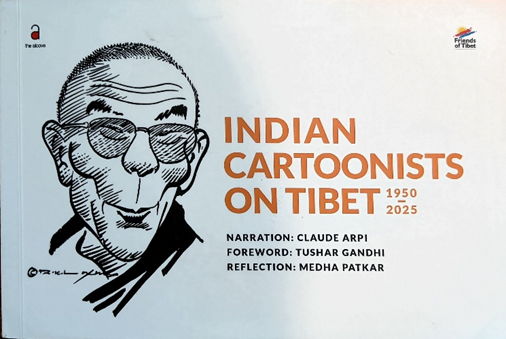
Indian Cartoonists on Tibet (1950–2025) is a compelling visual chronicle of Tibet’s long and painful journey, told not through conventional history but through the sharp, fearless ink of India’s most fearless and leading cartoonists.
Spanning over seven decades, the book captures the evolving relationship between India and Tibet. It highlights moments of solidarity, silence, diplomatic and moral dilemma and the tragedy of a lost homeland. At its heart is His Holiness the XIV Dalai Lama, a spiritual leader in exile, a Nobel laureate and a global symbol of peace and compassion, whose life and legacy are reflected in these powerful illustrations. His ever smiling face has remained a remarkable expression of resilience despite the loss of his kingdom and homeland depicted grandly in the book. One can say so much about a man who kept smiling even after losing his kingdom? HH Dalai Lama’s early pictures will tell you that.
The cartoons are far more than satire. They are acts of truth-telling. With wit and poignancy they reveal what headlines often miss: The heartbreak of displacement, the courage of resilience, the complexities of India-China relations, and the quiet strength of people who refuse to be forgotten. They also remind us that India not only lost a peaceful neighbour but also a serene Himalayan frontier.
In a world where voices are often silenced, cartoonists become the storytellers of humanity, distilling complex realities into strokes that inform, provoke and inspire.
The collection features 34 renowned Indian cartoonists as follows:
Shankar, R.K. Laxman, Chandi, Ranga, Vijayan, Abu, Mario, Thackeray, Ninan, Puri, Kaak, Prriya Raj, Yesudasan, Varma, Nanda Soobben, Ravi Shankar, Ponnappa, Manjula, Morparia, Abe Gowda, Prakash Shetty, Mrityunjay, Unny, Jayanto, Shankar, Manjul, Sajith Kumar, Suku, Satish Acharya, Soumyadip Sinha, Narendra, Thommy, Krish and Eskay.
The narration opens with an enlightened message from His Holiness the Dalai lama followed by a stimulating endorsement by Prof Samdhong Rinpoche. The crisp foreword is by Tushar Gandhi, author and great-grandson of Mahatma Gandhi and Kasturba Gandhi. The all-encompassing preface is by French born author, researcher and Tibetologist, Claude Arpi, followed by reflections (We The People of India and Friends of Tibet!) by Medha Patkar, Social Activist and founder of Narmada Bachao Andolan. And then you have ‘Smile over Tears’ by Sethu Das, Founder and Friends of Tibet Foundation.
Each cartoon (in all 50 plus) is accompanied by Arpi’s peppy commentary, placing the drawings within the historical and political context of Tibet, China and the complex Indo-China relationship.
His Holiness the Dalai Lama reminds us that humour should not demean others but bring people together. The ability to laugh at oneself creates common ground and makes laughter wholesome.
Prof. Samdhong Rinpoche calls the cartoonist a uniquely important communicator and praises the collection and commentary as excellent, noting the power of visual expression to transcend spoken language.
Tushar Gandhi, sees the book as an engaging visual chronicle of India’s relationship with China. The early cartoons, particularly those addressing the Nehruvian era, offer direct and often unsettling criticism of diplomatic decisions. The book, he says, is also a mirror of changing political ideologies, public consciousness and India’s ethical engagement with the Tibetan cause.
Claude Arpi describes the book as the story of the tumultuous years in the life of the Dalai Lama and the fate of Tibet. Despite the global recognition of the Dalai Lama as a man of peace, the older world order (Power, money, violence, etc.) still prevails and the fate of the Tibetan people is ignored. Claude cities Dalai Lama’s favourite quote, “If it can be remedied, there is no need to be unhappy. If it can’t be remedied, what is the use of being unhappy?”
Medha Patkar, the founder of the Narmada Bachao Andolan, writes about, Tibet’s culture, surviving in exile and credits the Dalai Lama and his team for creating Dharamshala as a centre and symbol of the Tibetan freedom movement. She invokes the spirit of “We, the People of India and Friends of Tibet”, recalling the worldwide support for the Tibetan cause and urging continued solidarity with Tibetans.
Says, Sethu Das, Founder of the Tibet Foundation: Friends of Tibet’s cartoon journey began with Mario Miranda (1926-2011), the celebrated cartoonist from Goa. As a steadfast supporter of the Tibetan cause, Mario served as an advisor for Friends of Tibet’s Festival of ‘Tibet 2000’ in Mumbai, inaugurated by the Dalai Lama himself. In one of our several conversations, His Holiness once asked me, “Why don’t you make your supporters laugh using cartoons instead of making them shed tears over photographs on Tibet?” It was this question that sparked the initial idea for Indian Cartoonists on Tibet.
Published by The Alcove Publishers in association with Friends of Tibet Foundation, the book grew from a travelling exhibition into a powerful visual record. It is ultimately a tribute to art as resistance, memory and hope—and to the cartoonists who drew so that others could see.
In these drawings, history smiles, protests, questions and sometimes grieves. And above all it remains the eternal smiling face of the Dalai Lama—a smile that says that even when a kingdom is lost, dignity, compassion and hope need not be.
(Kamlesh Tripathi is the son of the person who received HH Dalai Lama when he entered India in 1959)
Written and posted by Kamlesh Tripathi
Author, Poet, & Columnist
*
https://kamleshsujata.wordpress.com
*
Like it and Share it
*
Shravan Charity Mission is an NGO that works for poor children suffering from life-threatening diseases, especially cancer. Our posts are meant for our readers, including children and adults, and have a huge variety of content. We also accept donations for our mission. Should you wish to donate to the cause of cancer? The bank details are given below:
NAME OF ACCOUNT: SHRAVAN CHARITY MISSION
Account no: 680510110004635 (BANK OF INDIA)
IFSC code: BKID0006805
***
 Shravan charity mission